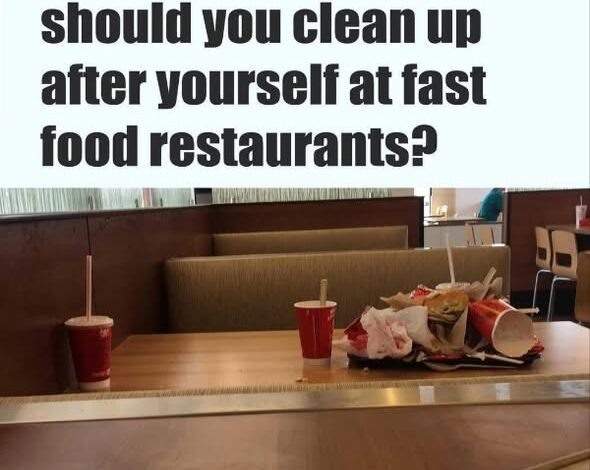
The etiquette of dining in fast-food establishments has long served as a subtle litmus test for one’s philosophy on social responsibility and the invisible contracts of public life. While the transaction appears straightforward—money is exchanged for a meal—the aftermath of that meal reveals a profound divide in how individuals perceive their role within a shared environment. This debate over whether a customer should clear their own tray or leave the remnants of their dining experience for the staff is not merely a question of logistics; it is a reflection of how we view service, labor, and the ripple effects of our personal presence in the world.
For a significant portion of the dining public, the act of gathering one’s trash and disposing of it in the provided receptacle is an unquestionable tenet of basic human decency. To these individuals, the “fast-food model” is built upon a foundation of self-service that extends beyond the counter. By clearing their own table, they see themselves as participants in a communal effort to maintain a pleasant environment. It is a small but meaningful gesture aimed at easing the burden on a workforce that is often understaffed and perpetually overtasked. In this worldview, the table is not a rented piece of real estate where one is entitled to leave a mess; rather, it is a temporary resource held in trust for the next person. Leaving it clean is a quiet ritual of respect—a way of saying, “I value the stranger who will sit here after me.”
This perspective is rooted in the belief that public life is made more bearable through a series of minor, collective courtesies. When a customer carries their tray to the bin, they are contributing to the aesthetic and hygienic upkeep of a space that belongs to everyone. They recognize that a staff member forced to spend their shift primarily as a busser is a staff member who has less time to ensure the floors are mopped, the soda fountains are stocked, or the bathrooms are sanitized. To this group, leaving a mess behind feels like an act of unnecessary entitlement, a dismissal of the dignity of service workers who are paid to facilitate a dining experience, not to act as personal attendants.
On the other side of the partition, there exists a viewpoint defined by the strict boundaries of the commercial transaction. For those who choose to leave their trays on the table, the argument is often framed around the definition of “service.” They contend that because they have paid for a meal in a commercial establishment, the responsibility for maintaining the cleanliness of that establishment falls squarely on the shoulders of the business and its employees. Some even argue that by cleaning up after themselves, they are essentially performing unpaid labor for a multi-billion-dollar corporation, potentially even providing a justification for the company to reduce its staffing levels.
In this more transactional line of thinking, the price of the burger includes the cost of the cleanup. These diners see no difference between the debris on their table and a smudge on the window or a scuff on the floor; all are maintenance tasks that fall under the purview of management. There is an underlying belief that the hospitality industry, even at its most “express” level, implies a certain degree of being looked after. To them, the expectation of self-clearance feels like a slow erosion of service standards—a “do-it-yourself” culture that has gone too far.
However, the reality of the fast-food environment usually falls into a more nuanced middle ground. While most modern quick-service restaurants are designed with the assumption that customers will dispose of their own waste, the “unspoken rule” is rarely about total sanitation. No reasonable person expects a customer to produce a spray bottle and a cloth to disinfect the laminate surface or to sweep up every stray crumb from the linoleum. The true point of contention is the “disaster”—the half-eaten sandwiches, the spilled dipping sauces, and the crumpled napkins that turn a dining area into a graveyard of consumption.
The table a person leaves behind is, in many ways, a mirror held up to their own social consciousness. It reflects the degree to which an individual believes their presence should affect the lives of those around them. When a table is left in a state of chaos, it creates a negative chain reaction. The next customer must either hover awkwardly waiting for a staff member to notice the mess, attempt to clear the previous person’s debris themselves, or sit in a state of discomfort. This creates a friction in the social fabric that is entirely avoidable through thirty seconds of effort.
Furthermore, the “job creation” argument—the idea that leaving a mess ensures work for employees—is often viewed by service industry veterans as a hollow justification. In reality, most fast-food employees have a checklist of duties that far exceeds the hours in their shift. Being forced to stop the flow of orders or the deep-cleaning of high-touch surfaces to deal with a mountain of trash left by a capable adult is rarely seen as a benefit to the employee’s job security. Instead, it is a source of frustration and a bottleneck in an industry that prizes speed and efficiency.
Ultimately, the debate highlights a broader cultural shift in how we navigate shared spaces. As we move toward more automated and self-sufficient service models, the boundaries of personal responsibility become blurred. Yet, the core of the issue remains human. Public spaces thrive when they are treated with a sense of collective ownership rather than individual entitlement. A fast-food restaurant is a shared stage where dozens, if not hundreds, of stories intersect daily. Each person who passes through has the opportunity to either degrade that stage or leave it ready for the next act.
Choosing to clean up after oneself is an acknowledgment of our shared humanity. It is a recognition that the person behind the counter is a peer who deserves a manageable workload, and that the person entering the door behind us is a neighbor who deserves a clean place to eat. While the law of the land might not require a diner to lift a finger once their meal is finished, the law of community suggests otherwise. Public life is not just a series of transactions; it is a series of interactions. By choosing the quiet courtesy of clearing a tray, we affirm the idea that we are all responsible for the quality of the world we inhabit together. It is a small act of grace in a fast-paced world, proving that even in a place built for speed, there is always time for a little bit of respect.