Amidst the cacophony of the internet’s viral sensations, one peculiar video has captured the attention of global audiences. In this digital age where information spreads like wildfire, a seemingly ordinary American woman has become an unexpected protagonist in a narrative that challenges conventional notions of identity and societal norms.
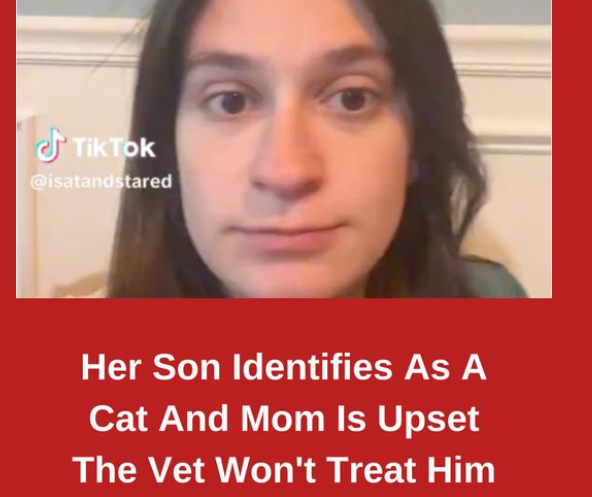
The video, disseminated by a British commentator who ominously forewarned of societal collapse, features the American woman candidly sharing her perplexing ordeal. She reveals that her son, with an earnest conviction, identifies as a cat. What ensues is a discourse that traverses the boundaries of rationality, sparking debates on the fringes of acceptance and skepticism.
At the heart of the controversy lies the woman’s lamentation: despite her son’s steadfast identification as a feline, a veterinarian purportedly denied treatment, citing the undeniable reality of his human anatomy. It is this clash between subjective identity and objective reality that forms the crux of the woman’s grievance, casting a spotlight on the intricacies of discrimination and inclusion.
For the woman, her son’s assertion of being a cat transcends mere whimsy; it is a fundamental aspect of his being that warrants recognition and accommodation. In her impassioned plea for understanding, she asserts that her son’s self-professed identity should afford him the same rights and privileges as any other member of society. To her, the denial of veterinary care based on his human physiology is tantamount to discrimination—a stark reminder of the pervasive biases that persist in our ostensibly progressive world.
Despite her indignation, the woman maintains a stance of reluctant forbearance, opting not to pursue legal recourse against the veterinarian. Instead, she advocates for a broader societal shift in perception, advocating for the inclusion of individuals who identify beyond the confines of human norms. In her view, those who assert their identity as animals should be granted access to veterinary care—a plea that underscores the evolving landscape of identity politics and the imperative of compassionate understanding.
The dissemination of this video has catalyzed a spectrum of reactions, with conservative factions interpreting it as symptomatic of a society in decay. To them, the woman’s narrative represents a departure from traditional values and a harbinger of societal disintegration—a sentiment echoed in the dire warnings of the British commentator who first shared the video.
However, amidst the polarizing discourse, there emerges a poignant reflection on the complexities of human identity and the inexorable march of progress. The woman’s advocacy for her son’s recognition as a cat serves as a microcosm of broader struggles for acceptance and inclusivity, challenging preconceived notions of normalcy and inviting a more expansive understanding of what it means to be human.
In the final analysis, the viral video serves as a compelling testament to the multifaceted nature of contemporary society—a society grappling with the nuances of identity, discrimination, and social cohesion. It beckons us to confront our own biases and preconceptions, urging us to embrace the diversity of human experience with empathy and open-mindedness. For in the tapestry of humanity, it is the acceptance of difference that truly binds us together in commonality and compassion.
Amidst the cacophony of the internet’s viral sensations, one peculiar video has captured the attention of global audiences. In this digital age where information spreads like wildfire, a seemingly ordinary American woman has become an unexpected protagonist in a narrative that challenges conventional notions of identity and societal norms.
The video, disseminated by a British commentator who ominously forewarned of societal collapse, features the American woman candidly sharing her perplexing ordeal. She reveals that her son, with an earnest conviction, identifies as a cat. What ensues is a discourse that traverses the boundaries of rationality, sparking debates on the fringes of acceptance and skepticism.
At the heart of the controversy lies the woman’s lamentation: despite her son’s steadfast identification as a feline, a veterinarian purportedly denied treatment, citing the undeniable reality of his human anatomy. It is this clash between subjective identity and objective reality that forms the crux of the woman’s grievance, casting a spotlight on the intricacies of discrimination and inclusion.
For the woman, her son’s assertion of being a cat transcends mere whimsy; it is a fundamental aspect of his being that warrants recognition and accommodation. In her impassioned plea for understanding, she asserts that her son’s self-professed identity should afford him the same rights and privileges as any other member of society. To her, the denial of veterinary care based on his human physiology is tantamount to discrimination—a stark reminder of the pervasive biases that persist in our ostensibly progressive world.
Despite her indignation, the woman maintains a stance of reluctant forbearance, opting not to pursue legal recourse against the veterinarian. Instead, she advocates for a broader societal shift in perception, advocating for the inclusion of individuals who identify beyond the confines of human norms. In her view, those who assert their identity as animals should be granted access to veterinary care—a plea that underscores the evolving landscape of identity politics and the imperative of compassionate understanding.
The dissemination of this video has catalyzed a spectrum of reactions, with conservative factions interpreting it as symptomatic of a society in decay. To them, the woman’s narrative represents a departure from traditional values and a harbinger of societal disintegration—a sentiment echoed in the dire warnings of the British commentator who first shared the video.
However, amidst the polarizing discourse, there emerges a poignant reflection on the complexities of human identity and the inexorable march of progress. The woman’s advocacy for her son’s recognition as a cat serves as a microcosm of broader struggles for acceptance and inclusivity, challenging preconceived notions of normalcy and inviting a more expansive understanding of what it means to be human.
In the final analysis, the viral video serves as a compelling testament to the multifaceted nature of contemporary society—a society grappling with the nuances of identity, discrimination, and social cohesion. It beckons us to confront our own biases and preconceptions, urging us to embrace the diversity of human experience with empathy and open-mindedness. For in the tapestry of humanity, it is the acceptance of difference that truly binds us together in commonality and compassion.